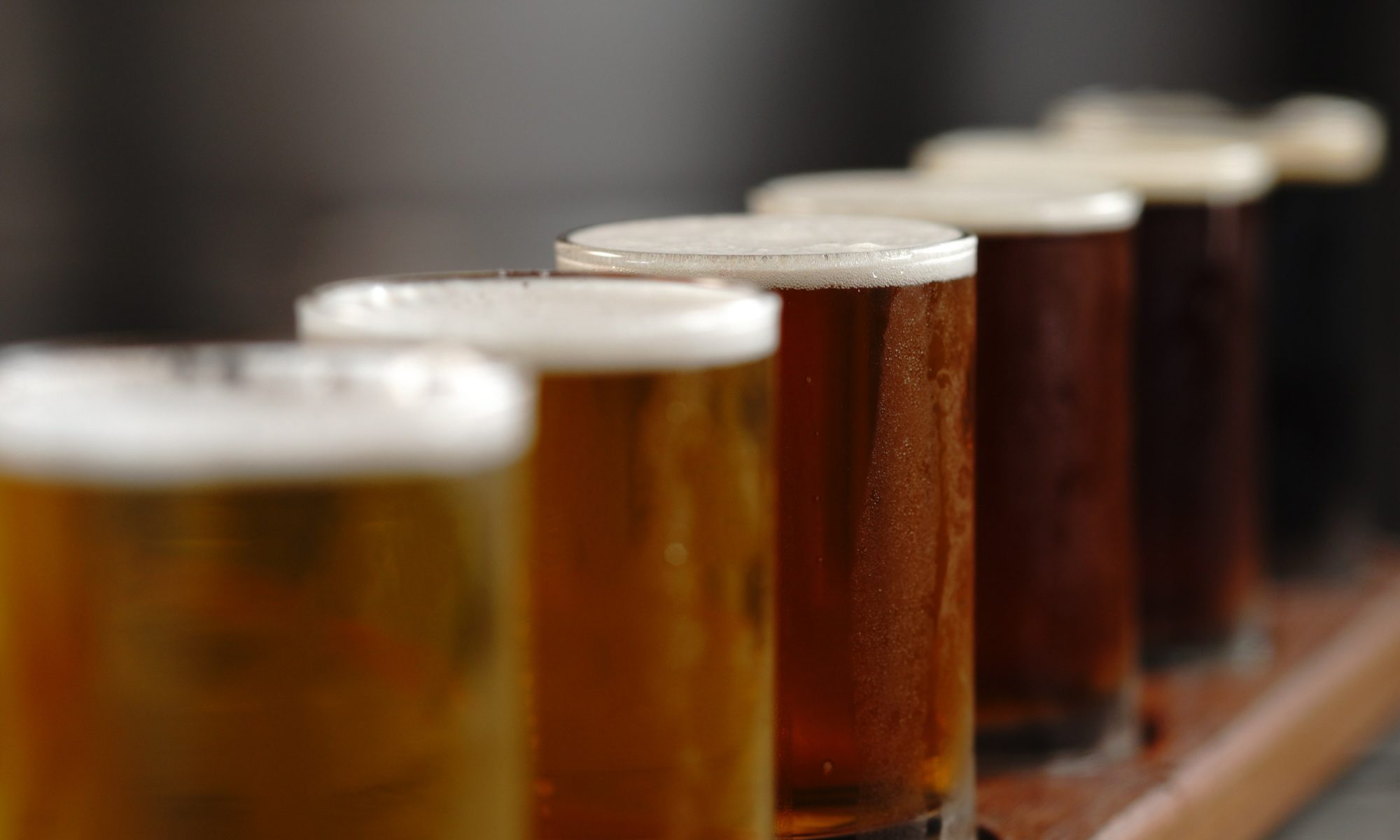
The lager is in the cellar finishining its fermentation. Two weeks of 14C and a slow fermenting yeast. There have been some strong H2S smells coming from it. Now it appears to have finished. It’ll be tested and put in a corny keg over the weekend. After 4-6 weeks in the garage we’ll have a better idea how it’ll come out.
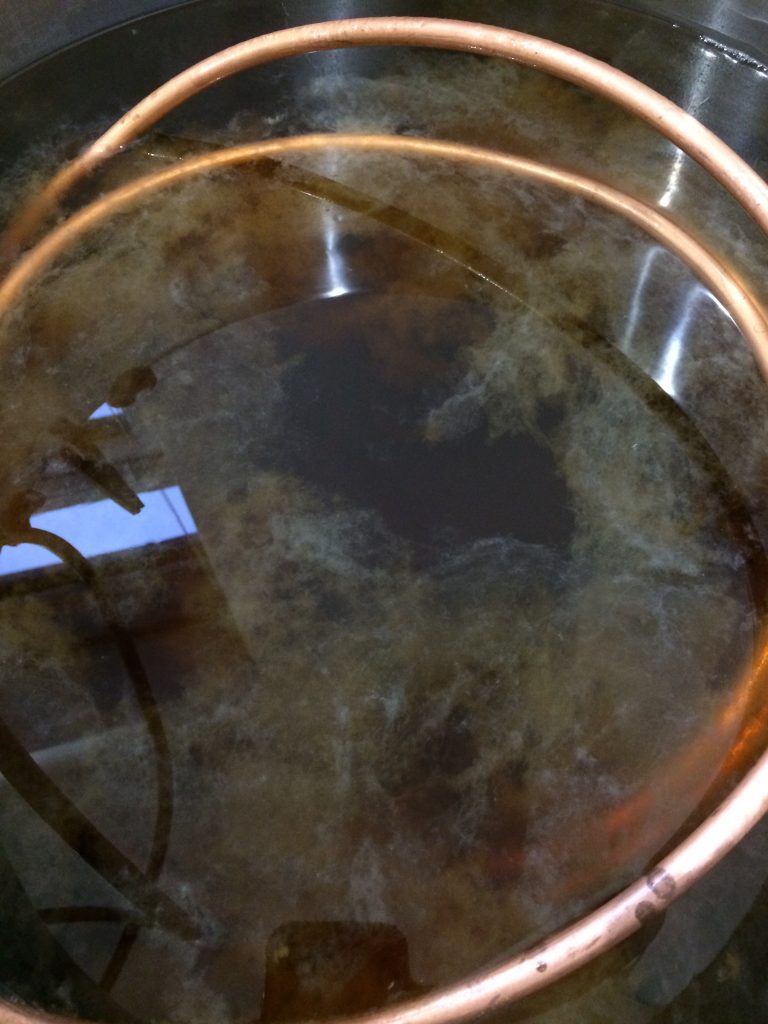
It’s looking a lot darker than we expected. It had a long (90m) boil with the top open so maybe it caramelised a bit.
All went according to plan, except that we finished up with more than expected. The boiling didn’t evaporate enough water so we had 700ml extra. Fortunately the efficiency was higher so the OG was as expected. The FG was actually a fair bit lower. I guess the WLP002 did much better than expected (normally 63-70%, actual 79%). Maybe the small starter helped.
Currently it’s being forcibly carbonated. Not sure when Pen will test it as she’s trying Dry January.
The next two beers will be brewed just before Christmas. The plan is to spend the weekend of the 21st brewing a bitter and a lager. Yes, a lager. Our first. We don’t have temperature control so the plan is to ferment in the cellar at about 10-14C and then we’re hoping for a cold winter and might leave it outside on cold days/nights to cold crash. We’ll have to see.
The bitter is another attempt at Coniston Bluebird. Hopefully this time it’ll brew without an infection. It was quite tasty last time and we were quite annoyed to have to tip it all down the drain.
Special RealAletionship v2 is now in the keg and the bottle. The bottles are primed so will condition and the keg is being force carbonated. Hopefully they’ll all be ready in a week.
For our first full grain since the infection we decided to try out our simplest recipe. Special RealAletionship consists of just Maris Otter, Magnum for the bittering, S-04 and a choice of hop for aroma/flavour.
Any off flavours should be quite apparent in the base beer. If this works without issue then we’ll move on to something more complex. We didn’t want to waste a load of expensive grain if the infection was still there.
The aroma hop we picked was GP75 from Stock’s Farm. We’ve not used it before so it’s bit of a wildcard. Pen sniffed the open pack and she liked it so we’re hoping for the best.
We brewed it over a week ago and now it’s just sat in a coldish room with the hops slowly imparting their oils.
We’re going to keg most of it next weekend and force carbonate. The rest will be bottled, some for long term testing and some for the Home Brew Club.
The kit’s now been bottled – 4 x 330ml and 4 x 500ml of each split. No infection and lots of fruity smells. Pen still thinks that the base beer is pretty poor but we’ll leave it a while to see if it improves, like the previous one did.
Our kit has been thoroughly cleaned, well most of it has. On Monday it was time to test it out so we used an old kit (a year past its best) with new yeast. If we manage to brew without infection or off-tastes when we’ll know that, at least, some of our kit is ok.
A full-grain brew is still a way off. We’re short of buckets and some tubing, and there’s still a fair few components which haven’t been cleaned/disinfected/sanitied/sterilised properly or at all. And we still have to clean the room itself.
The plan with the kit beer is to split it (into the non-existant buckets) and use up a fair quantity of hops doing some serious dry hopping. The kit beer itself is pretty poor so we’re hoping that a) the hops will make it drinkable and b) we improve our knowledge on hopping and hop combinations.
The last one was a Coniston Bluebird clone but we had to dump a corny keg full of it because of an infection.
We think that doing wild ferments of wort or mash in the small plastic buckets caused them to become permanently innoculated. Then using these buckets to shift grain and wort around just spread the infection.
Over the last couple of months we’ve been slowly documenting all our kit, breaking it down into component parts and cleaning them. We have a spreadsheet of items v. cleaning methods. The various method are washing powder, VWP, Bruzyme, Bruclean, Washing machine, dish washer, oven, steam, starsan. Some stuff will get most of these, some just one or two. The longer the beer says in contact with an item, the more we’ll clean it. Obviously the fermenters are most vulnerable so they’ll be cleaned many times.
We’re replacing all the tubing, many of the seals and all the buckets. We’ll keep the fermenters, unless we see further infections.
We also want to clean the brewing room itself just in case something is clinging to the walls or ceiling.
Once we’ve cleaned and replaced everything we’ll brew an old kit and hope that there’s no infection. The Simply Pale Ale kits aren’t great so we’re planning on splitting it and using a serious quantity of a variety of hops to hide the bad flavours.
Another June, another set of weird ingredients. This year we weren’t as prepared as we could have been. Our holiday was booked around Home brew Sunday because we really wanted to take part but, stupidly, we left it rather late to pick up ingredients to take along.
Thus we found ourselves at a farm shop between Sussex and Manchester picking up random items and asking “Will it brew?”. We came home with liquorice, stuffing and pork scratchings with the intention of inflicting one on some expectant sap the following day.
Actually, what happened was that we liked the look of the expensive liquorice, the posh stuffing and the fancy pork scratchings so popped into Morrisons on the way to the event. There we picked up some Morrisons own brand sage and onion stuffing instead. Practically it would have been difficult for anyone to find the same, fancy, ingredients if they didn’t have enough (unlikely).
On the day people brought along quite an eclectic set of items, including a surprising number of Oriental options such as wasabi and miso. James took down a list of who brought what which I’ll point to once he’s published it.
Our stuffing finished up in the hands of expert sour brewer Keith Sowerby. Steve got kidney beans, which he was less than happy about as they “have no taste!”.
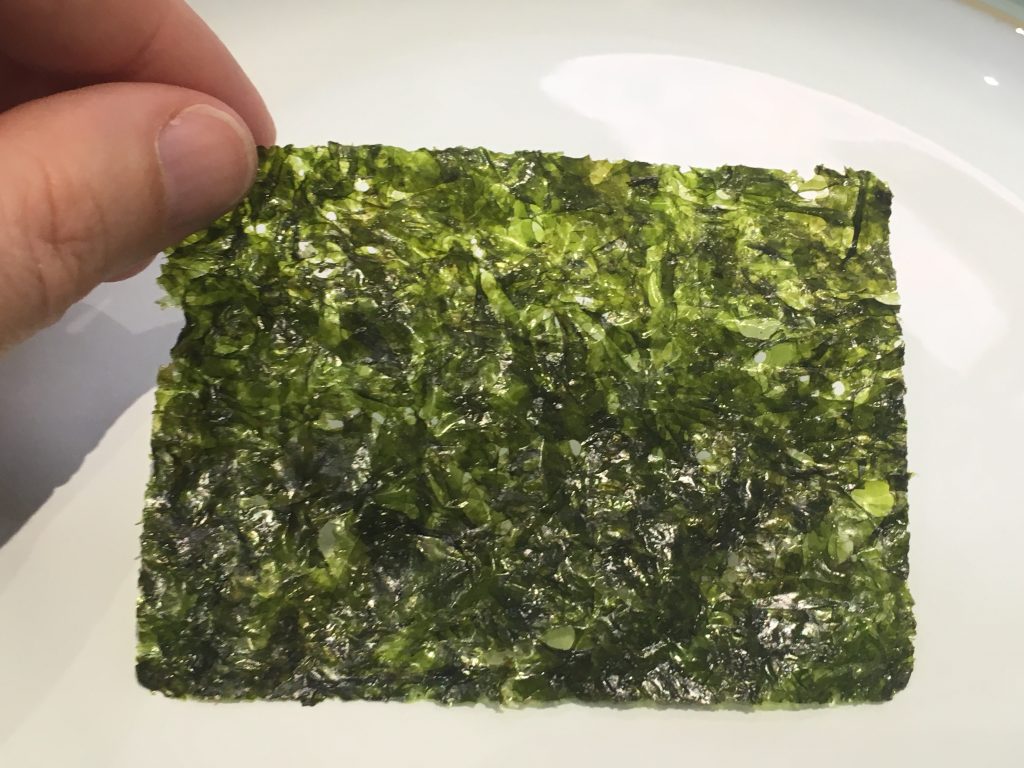
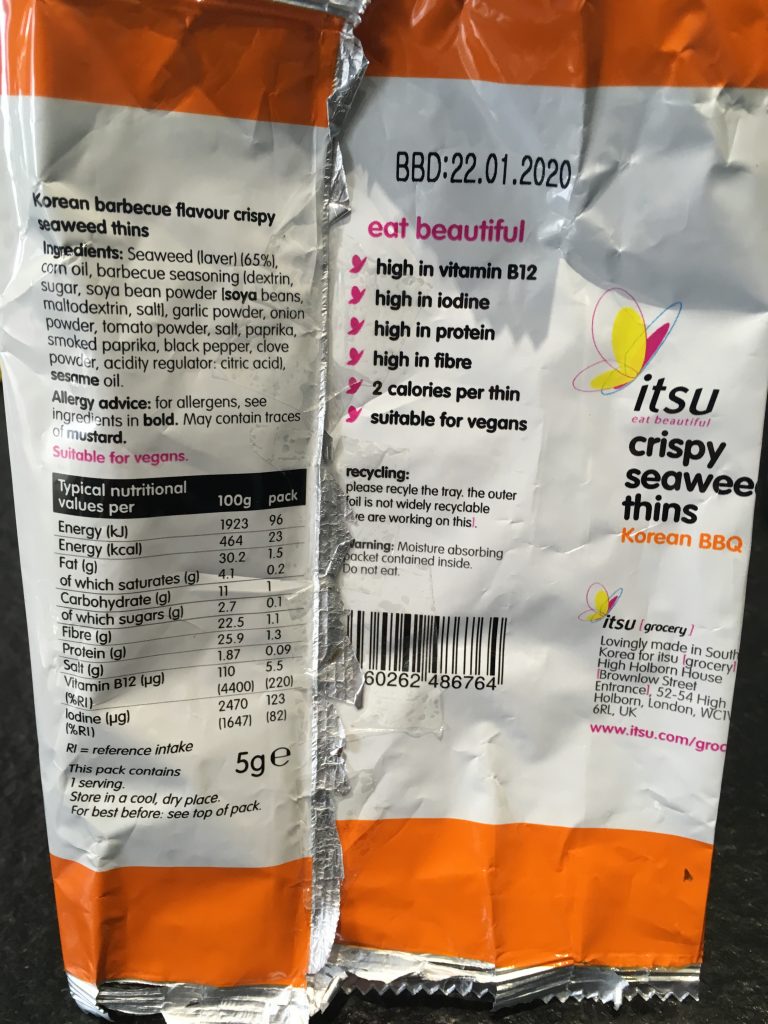
Beardy Dan (mead maker Snoring Bear) sent in absentia a bag of Korean BBQ flavoured crispy seaweed thins, which are now our ingredient we have to brew with. There’s so much wrong with this. BBQ? Seaweed? The massive bags contain no more than 45g in total. Of that about 20g is fat, not a brewer’s friend.
Yes, it’s translucent.
Left for a week to see what happens to the BBQ flavour
Not processed, oh no.
Last week we tasted one each. Pen quite liked them, Mike not so much. They live up to their name. Definitely Korean BBQ flavoured. Definitely Seaweed and very, very thin. Each weighs less than 1g, roughtly 0.3g.
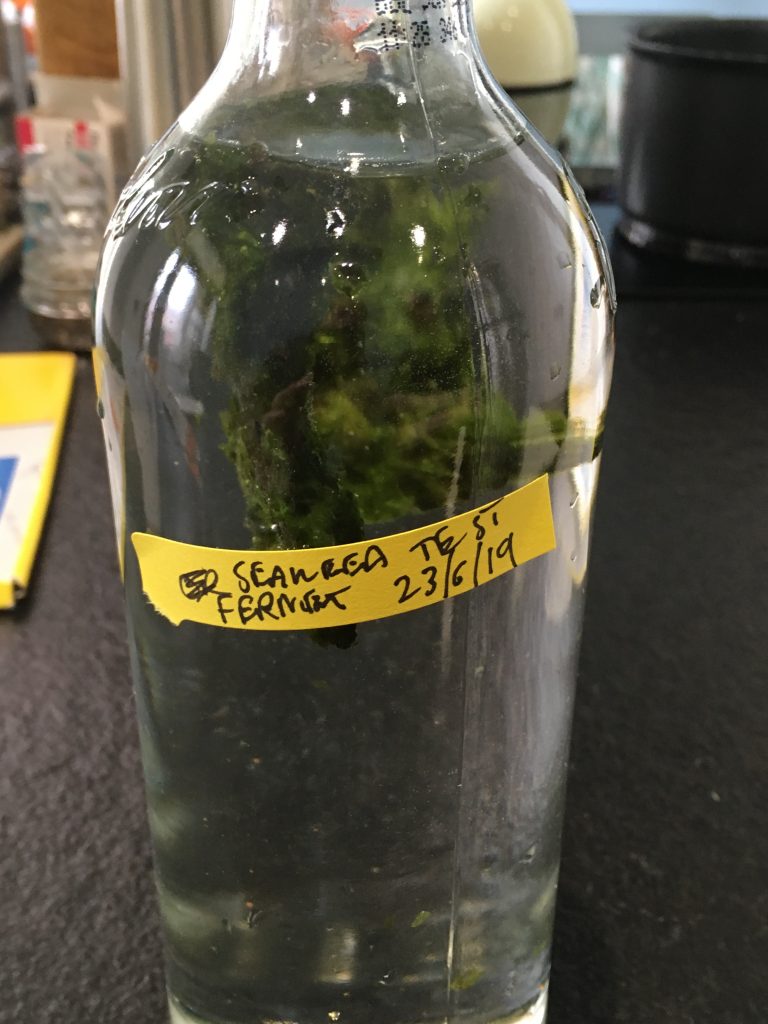
This weekend we decided to see what happened when we immersed them in water. One thin each in a ‘mash’ (thermos flask) at about 67C for an hour, boiled for 15 minutes and left in room temperature water for a week.
The boiled one smelled of seaweed whilst boiling but the intensity dropped after 10 mins. There was plenty of flavour in the remaining water though.
The mash seemed less successful with less flavour in the liquid. We’ll have to wait to seee what happens to the one in the bottle of 20C water.
As research we contacted a couple of breweries known to make seaweed beer. One, Portsmouth Brewery from Maine, replied and offered some useful advice and information. Thanks Maxine. She gave us an idea of quantity to use (26g/L towards the end of the boil) and a description of the flavours in the final beer. She advised to keep the hops bittering low too.
What are we going to brew? Probably our basic Magnum Blonde with a higher salt contribution, mininal bitterness and a typical FG. Hopefully this will balance to salt, bitterness and sugar with the umami from the seaweed. Intially we’re thinking of aiming for about 5g/L thin at the end of the boil (5-10 minutes). We’re assuming a 5:1 ratio of the mass between wet and dry seaweed. It’s a guess based on our hops.
Depending on the 20C water test we might ‘dry hop’ the beer to get the BBQ flavour too. We’re going to have to buy more of them as we don’t have enough.